.jpg)
Scaling Campaign
Imagery with AI
AT A GLANCE
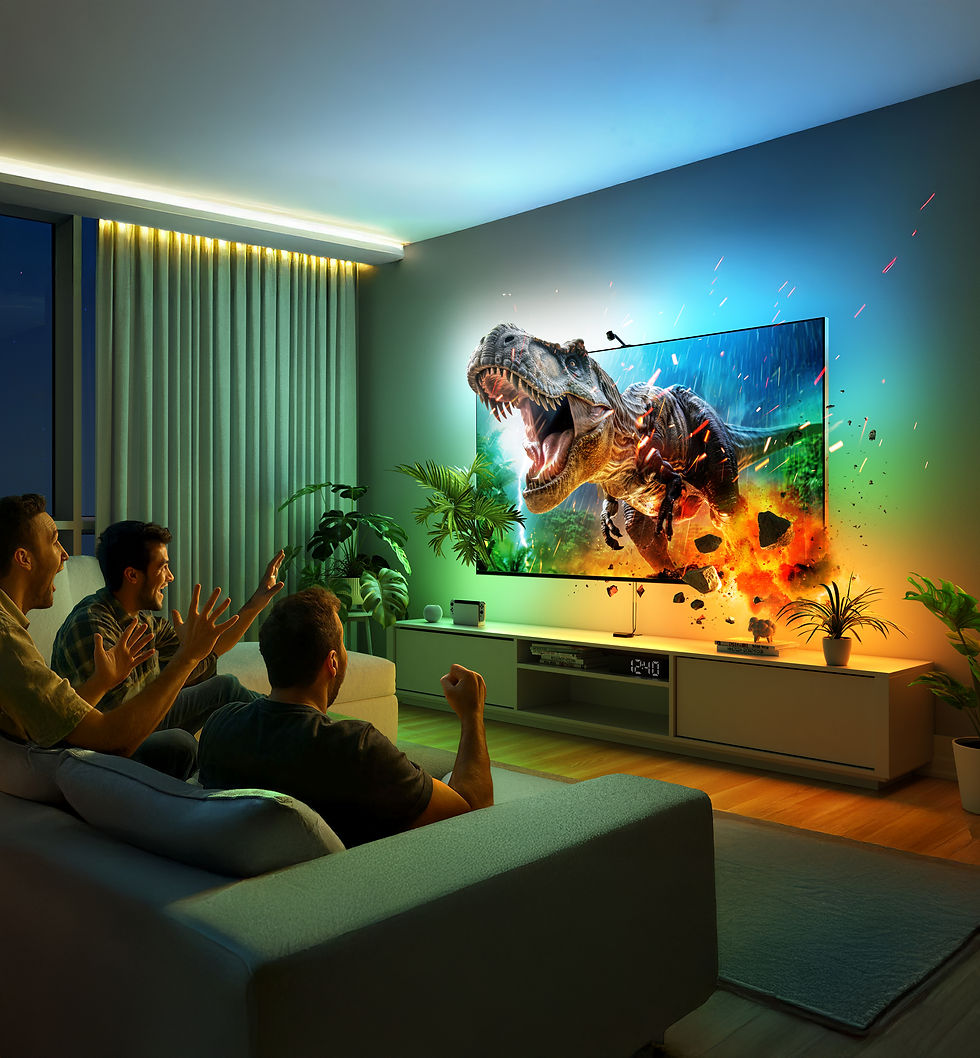
Seasonal campaigns at Nanoleaf demand a high volume of fresh, evocative imagery, yet our traditional production pipeline have often be a bottleneck for speed and variety. Working with our team, we explored the gap by exploring how AI can augment our existing assets as a "creative multiplier." By using a single render as a base, we've tested how to rapidly generate a diverse range of campaign visuals that feel unique yet unmistakably Nanoleaf.
This project is in an exploratory phase, testing AI-assisted workflows, refining prompts, and identifying ways to communicate best practices for branding across the team. The goal is to move from “experimental” to “operational” by documenting repeatable visual logic, building a brand guide for AI integration, and standardizing prompts that reflect Nanoleaf’s lighting and material qualities.
ROLE
Art Direction
AI-Assisted Image Exploration
Prompt Development & Refinement
Image Curation & Refinement
DELIVERABLES
Key campaign visuals
AI-assisted variations
Scalable visual systems
LIVING ROOM TO BEDROOM FLIP
.jpg)
BASE IMAGE


THE RESULTS
Defining the Prompt DNA
The success of AI imagery starts with brand vocabulary. We don't just "generate"; we translate existing brand pillars into a specific prompting syntax.
-
The Nanoleaf Aesthetic: Clean lines, modern interiors, and "lived-in" minimalism.
-
The Lighting Logic: We utilize dim ambient lighting to ensure the product remains the hero. By specifying RGB lighting fixtures, we allow the AI to cast accurate color spills onto the surrounding environment.
-
Technical Benchmarks: To ensure the output meets campaign standards, we integrate parameters like "Generate in 4K" and specific aspect ratios to maintain high-resolution integrity for web and print.
From Hero Shots to Micro-Campaigns


The Challenge: Proprietary Accuracy
AI models often struggle with proprietary industrial design, frequently hallucinating or replacing complex lighting products with generic household objects. To solve for this, I developed a hybrid workflow:
-
Image-to-Image Referencing: Feeding the AI simple, high-contrast base renders of the products to lock in the silhouette and scale.
-
Contextual Anchoring: Including URLs to product pages within the workflow to provide the model with a deeper "understanding" of the product's physical properties and textures.

BASE IMAGE


THE RESULTS
Key Takeaways
AI is a partner in creativity, not a shortcut for quality.
-
Not a "Quick Fix": High-quality AI generation can be a labor-intensive process. It requires significant time to craft the right prompt architecture and vet the outputs.
-
The Designer’s Eye: Scaling imagery requires a human "quality scan." I meticulously check for detail accuracy to ensure the product is never misrepresented by the AI’s generative tendencies.
-
The Final 10%: AI rarely delivers a finished product. Every image still undergoes fine-tuning in post-production to align with Nanoleaf’s exact color science and polish.